Understand your chart.
Not just your sign.
Astrology is a language made of symbols. Learn how your natal chart is constructed and—more importantly—how it's interpreted.
Credit: NASA/JPL-Caltech
The sky of July 2026
Un mes de giros inesperados, revelaciones y un cielo cargado de propósito.
Julio de 2026 es un mes genuinamente eventful. Mercurio se arrastra por el final de su movimiento retrógrado antes de girar directo, mientras que Neptuno y Saturno se estacionan retrógrados, ralentizando considerablemente la atmósfera. Marte enciende un conjunto de aspectos poderosos en la primera semana, y Júpiter se enfrenta a Plutón cerca de la mitad del mes. El ingreso del Sol en Leo levanta el tono en el tercio final, donde un conjunto audaz de aspectos a finales de julio —trígono, oposición y sextil disparándose casi simultáneamente— lleva el mes a un cierre dramático.
07 julio 2026
The sky today
Sol
14° Cáncer
Luna
4° Aries
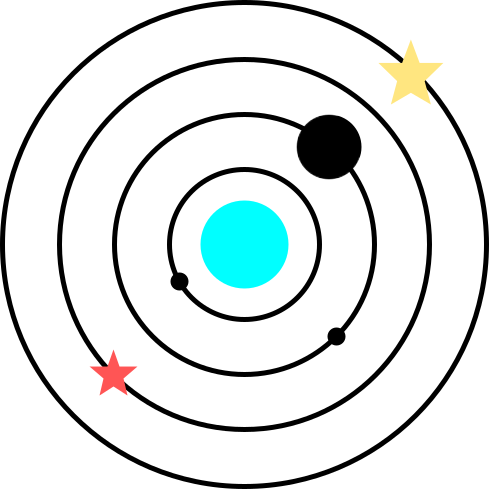
Earth at the centre
Reading the sky
Every chart you'll ever see places the Earth at its centre — just as people pictured the cosmos in antiquity. It isn't a mistake: astrology reads the sky as it appears from the ground, from where you actually stand and look up.
Here is that sky, part by part:
You, the observer, at the centre. The whole sky is drawn as it looks from where you stand.
Planets →The moving bodies — Sun, Moon and planets. Where they sit is what a chart actually plots.
Signs →The twelve slices of the zodiac, the fixed backdrop the planets move against. Each lends its style to whatever falls in it.
Houses →Twelve areas of life, fixed around the Earth. They turn the sky into a map of where things happen for you.
Angles →The turning points of the chart: the Ascendant rising on the horizon and the Midheaven overhead. They orient the whole wheel.
Your chart
Reading a natal chart
A natal chart maps the sky at the precise time and location of birth. These are its main components:
The four cardinal points of the chart.
The active forces in your natal chart.
The twelve styles of expression.
The twelve areas of life experience.
The relationships between planets.
The apparent backward motion of planets.
How it all fits together
You've seen the pieces — now see how they combine into a single chart.
Read the guide →Cosmic biography
Generate your 100 years of transits
Enter your birth date and location to get a complete picture of planetary transits starting from the day you were born.
Save your profile* — your cosmic biography and natal chart are included
☉︎
Natal chart
The sky of your birth, saved under your name and always at hand.
☽︎
Cosmic biography
Your hundred years of transits, generated once and kept forever.
+6
And every month, 6 free credits to unlock one reading of your choice:
*saving requires registration — it's free · You can save more than one profile with a single registration